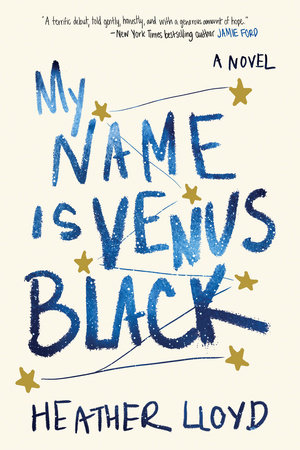
From Goodreads: “Venus Black is a straitlaced, straight-A student obsessed with the phenomena of astronomy—until the night she commits a shocking crime that tears her family apart and ignites a media firestorm. Venus refuses to talk about what happened or why, except to blame her mother. Adding to the mystery, Venus’s developmentally challenged younger brother, Leo, suddenly goes missing.” It also says, “In this gripping story, debut novelist Heather Lloyd brilliantly captures ordinary lives upended by extraordinary circumstances. Told through a constellation of captivating voices, My Name Is Venus Black explores the fluidity of right and wrong, the meaning of love and family, and the nature of forgiveness.”
I want to note straight off that I got this ARC from the publishers by accident. See, I got an email from a Penguin Random House publicist offering me copies of a few of their February releases. So, I clicked on the cover of this one, and it automatically ended up on my NetGalley dashboard. That made me feel obliged to read and review it, and now that I have done, I’m glad that I did, even though this is far from a perfect novel.
Let’s start with the problems I had with this book. To start off, Venus tells her story in first person, which is fine. However, using this mechanic, the narrator can’t be omnipresent, so this meant that Lloyd needed to move to third person narrative when delving into the action of the other characters. That is also totally reasonable, but it can be problematic if the author doesn’t do something to ensure that the two different points of view are kept distinct, in one way or another. For example, Michael Ondaatje, was able to overcome this by making the action that the protagonist couldn’t know about as part of the protagonist’s imagination. Other authors will alternate chapters to distinguish first from third person sections. Lloyd, however, did neither of these, and I found it disturbing and confusing when the point of view slipped between first and third person within chapters and sometimes even within the same paragraph.
The other problem I had with this book was its ending. There’s a whole section before the epilogue which attempts to tie things up nicely. While that can be good, the fact is that several of these solutions to felt highly unlikely and unbelievable. All things considered, with what happens in this book, I think this book would have had a much more powerful ending if everything after the titular line is said by the protagonist (sorry, can’t say more, to avoid spoilers) had been left out, and gone straight from there to the epilogue – which was outstanding. I believe that life isn’t tidy, and therefore fiction doesn’t need to clean things up for us. Furthermore, I also believe that authors do us a favor if they leave us guessing and imagining for ourselves what happens to these people after the end of their novels.
That aside, I must praise Lloyd on what was otherwise a very powerful and complex story, with very sympathetic characters. One of the things that made this book special is how Lloyd went about telling us what Venus did on that fateful night. Instead of giving us the whole picture in one fell swoop, Lloyd gives us crumbs all along the way. This keeps the readers guessing and while trying to understand everything about what happened, we also slowly get to know Venus better. I would go so far as to say that this is one of the most admirable examples of developing a compelling character I’ve ever read. All the characters here – not just Venus – grow and change throughout the book, without it ever feeling forced or unrealistic.
To top all that off, Lloyd also gives us a multifaceted story, with conjoining plots and timelines. This could easily have been confusing, but as Lloyd did with Venus’ crime, this all gets carefully pieced together by the end of the book. Admittedly, because of the book’s title, initially I did get slightly frustrated that this novel didn’t focus solely on Venus, but when I realized that this would have left out a very essential part of the plot, I decided this wasn’t a problem here, and in fact, Lloyd turnedit very much into a major advantage.
All told, this was a very happy accident for me to get this book. As far as characterizations and plots are concerned, this book was spot on the money, and written in a deceptively simple, but gripping prose. That I had a problem with some of the shifts in the points of view, and could have done without some of the ending, doesn’t mean that other readers won’t be able to ignore this (or disagree with me) and fully enjoy this novel. I think for all this, Lloyd has proven herself to be quite a talented writer (and one to watch out for), and I’m recommending this book with a solid four out of five stars.
Dial Press (a division of Penguin Random House) released "My Name is Venus Black" by Heather Lloyd on February 28, 2018. This book is available from Amazon, Barnes & Noble, Kobo Books, Kobo audio books, eBooks, iTunes (iBook or audiobook), The Book Depository (free worldwide delivery), new or used from Alibris or Better World Books as well as from an IndieBound store near you. I would like to thank the publishers for inviting me to read the ARC of this novel via NetGalley in exchange for a fair review.
In this collection of 11 stories, including “Brokeback Mountain,” Proulx looks at the many sides of the people and vistas of Wyoming, a state that according to most sources is the 10th biggest in land size, and the second least densely inhabited (behind Alaska). Landlocked by Montana, South Dakota, Nebraska, Colorado, Utah and Idaho, Wyoming has 2/3 of its western part covered by the Rocky Mountains and is home to both the Yellowstone National Park and the Grand Tetons National Park. With these stories, Proulx attempts to create the types of unique characters who would choose to make their lives within this vast natural beauty.
Often when a truly powerful film comes from a work of fiction, I feel the urge to read the original, but don’t always act on this impulse. In this case, although my intentions were very good, my procrastination was even better. This was probably because I’ve never been into the genre of Westerns. This push-and-pull went on for quite some time, and in fact, it went on so long that when I saw a copy at a very cheap price not long ago, I bought it right away. Silly me, I already had a different edition languishing on my shelves for maybe as many as five years. What made me finally take this book up was the desire to read some short stories. This sometimes happens after I’ve read a particularly long, or complex, or engrossing novel. That brings me to this, the review of this collection of short stories.
I have to say that it was clever of the publishers of the edition I read to put the “famous” story – “Brokeback Mountain” – as the last one in the collection. Of course, there’s nothing to stop people from reading that one first, but the psychology of saving the ‘best for last’ was obvious here. Admittedly, it is the best story here, mostly because it is the one that seems the most focused of the bunch, since most of the other stories seemed to wander away from the point at times. That isn’t to say that a bit of sub-plot isn’t a good thing, but in one or two of the longer stories I felt like the essence of the story was lost along the way. However, it is important to note that for the most part, these tales focus mainly on the heart of the people who live in this state, and the types of lives they live, and the juxtaposition of how harsh their lives are as compared to the beauty that surrounds them, and that comes through in everything Proulx gives us here. Despite the tough realities depicted here, once or twice Proulx was able to a smile to my face, but for the most part, these stories are actually very serious and dramatic.
Of course, those occasional additions of humor made reading such a collection of intense tales less strenuous, and admittedly most of these stories are difficult to read, but not solely because of the intense emotions or lack of comedy. What I found most trying were the times when I had a hard time understanding what the characters were saying. This is because in Proulx’s attempt to be authentic, led her to write the accent and jargon of the region very heavily into the dialogue. There were also times in the descriptions when Proulx referenced things that were lost on me, probably because I have no experience with the region or to certain events to which Proulx was referring. This made me feel a bit lost (and even stupid) at times, and sadly, that detracted from my overall enjoyment of this collection.
That said, there were two stories that I really liked. The first was, of course, “Brokeback Mountain,” partially because of the movie. But more than that, I found this story to be practically sparse compared to the film, but the impact was almost equal. I must admit, this is probably one of the best film adaptations of any work of fiction. The other story I really liked was called “A Pair of Spurs” which was one of the stories that felt like the focus digressed several times, but then Proulx brought it all back together with a real beauty and elegance that I found very admirable. The other thing in these stories that impressed me was how Proulx made such fascinating (and sometimes horrifying) female characters with these tales, particularly because our ingrained stereotypes for the Western genre would have us believe of the dominance of the men, with the women either overly tough or frail and submissive. Proulx’s nuances with her female characters were certainly refreshing.
Overall, although I enjoyed most of the stories in this collection very much, and generally appreciated Proulx’ writing style and unique characterizations, I can’t say that I fell in love with these tales. This may be because of the genre, or perhaps it was the heavy use of jargon and slang that kept me from getting truly engrossed in this collection. Despite this, I am certain that people who are true Western fans will really enjoy these stories, so for them I can still warmly recommend them. However, if you aren’t into Westerns, I you’ll probably agree that despite the genre, they’re worthy of a respectable three and a half stars out of five.
You can also read my review of Proulx’s Pulitzer Prize winning novel “The Shipping News” which was also made into a movie, but it was a very bad adaptation!
By the way, on May 2 the Library of Congress announced that they will award Annie Proulx their 2018 Prize for American Fiction! Talk about serendipity...