Pages

.

Between Two Sisters

A Fist Around the Heart by Heather Chisvin 


Goodreads says that “The story of Anna Grieve and her fragile older sister, Esther, begins in Russia in the 1880s. The vicious persecution of Jews has come to such a point that the girls’ mother makes the decision to send her children to Winnipeg with her wealthy employers.” They also add, “When Anna receives the unexpected news of Esther’s possible suicide on “If Day,” an unusual day in WWII history when a simulated Nazi attack took place in Winnipeg in order to raise funds for the war effort, she immediately returns to Canada. Only she can piece together what really happened all those years ago in Russia…” 

I must admit that after I got this book, I almost regretted the request and avoided reading it for a while. With all the depressing news across the globe, I wasn’t sure I was in the mood for something that sounded depressing, and for some reason I thought this was going to be more about the Holocaust. However, after realizing that this debut novel is something of a family history Chisvin, I decided to put my trepidation aside and get on with it, mostly because I like to read new authors, and partially because I’ve had a family history novel in my own head for a while now.

The problem with a book that is based in your own family history is that there are always so many stories you want to include. They’re the ones we grew up hearing, and they’re all so juicy. Unfortunately, not every piece of family legend makes good fiction, because novels require a central conflict for resolution. Combining large amounts of unconnected information, tends to pull the focus away from that conflict. For me, this was the biggest problem I found in Chisvin’s story, which was otherwise a fascinating tale. For example, there’s a whole section of the book where Anna ends up getting deported from the US to Soviet Russia. While I believe I understand why Chisvin kept this in the story (probably due to an earlier reference in the book), I felt this section, despite it being very interesting, was superfluous to the rest of the action in this book. 

I also got the feeling that Chisvin was conflicted in what to present here. Was this book supposed to be about Anna’s need to discover if Esther’s death was suicide, an accident, or murder? Or was it supposed to be a portrait of Anna, who was a truly remarkable woman, and worthy of a novel based on her adventures? It felt that Chisvin wasn’t ready to sacrifice either of these plots, and instead decided to combine them together, with them both as main storylines, without either of them taking a back seat to the other. To achieve this, Chisvin needed to include a whole lot of flashbacks, which in and of themselves were very appealing. However, for me, because the book follows both parallel plots, these many flashbacks end up muddling the focus of the story. What I’m trying to say here is that I think Chisvin should have written two novels and not just one. The first should have been Anna’s story, and the other should have been about the mystery surrounding Esther’s death. 

While writing this review, I suddenly thought about Rachel Joyce’s two novels – the first about Harold Fry and later, her book about Queenie Hennessey. In those two books, Joyce took one story and pulled them apart to show two connecting yet diverging sides of the same tale. Had Chisvin taken that example, she would have had not one, but two potentially five-star novels on her hand. I say this because I honestly believe Chisvin has shown about that much talent here, and that’s why I still enjoyed reading this novel. Chisvin knows how to stimulate her readers’ imagination, painting pictures of Russia, Winnipeg and New York that feel real and alive. Chisvin also showed a gift for writing believable dialogue, not to mention a flair for developing empathetic characters, and a forte for devising intriguing story lines. 

So, while I’m sorry Chisvin didn’t think of writing two books instead of one larger novel with two equally major storylines, I still think this was an admirable first novel. In fact, I look forward to seeing what Chisvin comes up with next time. For all this, I believe I can still recommend this book (with reservations and knowing full well that what bothers me might not detract from this book in someone else’s opinion) and give it three and a half stars out of five. 


Second Story Press released "A Fist Around the Heart" by Heather Chisvin on April 10, 2018. This book is available from Amazon, Barnes & Noble, Kobo Books, iTunes iBook, The Book Depository (free worldwide delivery), new or used from Alibris as well as from an IndieBound store near you. I would like to thank the publishers for sending me an ARC of this novel via NetGalley in exchange for a fair review.
reade more... Résuméabuiyad

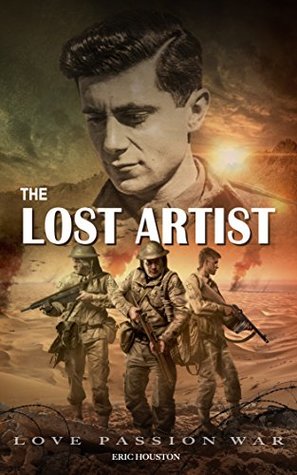
Q&A with Eric Houston, author of The Lost Artist: Love Passion War (Part 1)


I recently heard about Eric Houston's memoir "The Lost Artist: Love Passion War (Part 1)" and was immediately intrigued. While I couldn't fit this book into my reading list, I decided instead to feature this work here, by asking him one question. Here's his answer to:


What was one of the most interesting experiences you had when researching this book? 


I was stunned by much of what I found while researching The Lost Artist: Love Passion War (Part 1). My father knew they were all going to die at El Alamein, Egypt. It was July 3, 1942, the first two lines were wiped out, and his third line, the last line of defense, was out of ammo. But they all stood firm. If Rommel had broken through there was nothing to stop the Nazis. In Berlin, they were celebrating having won the war, and the Grand Mufti was setting plans to murder every Jew in Palestine and the Arab nations. 

My father always thought that it was a miracle for Rommel, at that last moment, to lose his ‘Fingertip feel’. In truth, it was. But my dad never knew the astounding series of events leading up to that, including the unbelievable blunder of US and British intelligence responsible for the death of over 100,000 allied soldiers and nearly costing us the war. The victors write history, and the cover-up was so important, history had to be rewritten. Even Churchill would perpetuate the Rommel myth. I hope someday we can honor the German resistance, working side by side with Joseph Goebbels at a Berlin radio station, who appear to have given their lives to stop the Nazis. Undoubtedly, they were erased from history. 

Still, for me, the most interesting experience was discovering the popularity of the little children’s book that my father had illustrated before leaving Israel for New York City in 1948. I had known And There Was Evening (Vayehi Erev) (ויהי ערב) because he brought it back from his one trip to Israel in the early 90’s. When he showed it to me he said in disbelief, “It’s a miracle. The book was actually published, and this one little bookstore that I happened to walk into somehow got the leftover copies from the 1950’s printing.” It never occurred to him that the book could have had more than one printing. 

After my father died in 2006, I started researching his remarkable story. I like to write what I know about, and this seemed overwhelming. Besides what he told me, what did I know of growing up through the rise of the Nazi Party, Palestine before the State of Israel, WW II’s North African Campaign, the No. 2 Commando, etc.? 

Then in 2010, I received an email from Einat Amitay, a top computer scientist with a chair at IBM Israel saying, “You may not know this, but your father is very famous in Israel.” I assumed it was a scam, but as I read on, instead of offering millions of dollars, she talked about a timeless, classic children’s book. After a sixty-year ongoing search for the artist, Einat, while dying of breast cancer, had joined the mission and against all odds solved the mystery. 

During our first Skype conversation I told Einat about my father thinking that it was a miracle to find a leftover copy in that little bookstore. She just laughed, saying, “He could’ve walked into any bookstore. It’s everywhere.” 

The story was now too much for me to resist. Very moved by Einat’s story of finding my dad, I wanted to tell it as a present day backdrop to telling his story of escaping Nazi Germany in 1934 at the age of 13 by going alone to Palestine, entering the Haganah at age 14, where he helped to save countless illegal Jewish immigrants, befriending many Arabs, including King Abdullah of Jordan, in an attempt to unite Jews and Arabs so that they could build a great nation together, and WW II’s North Africa Campaign. 

Though Einat made it clear that her chances of survival were slight, she was so vital and such an amazing person that it was hard for me to accept. How many people dying of breast cancer would have the determination to join a 60-year search for a lost artist of a favorite children’s book and be the one to succeed?! I can’t say how grateful I am to her. She did so much for so many. Without Einat, I never would have written The Lost Artist. I wish my father could have known her, but she felt his spirit was guiding her on the mission. So who knows… Maybe they know each other now.

About the book and the Author:


The Lost Artist: Love Passion War (Part 1) utilizes the Israeli researcher’s quest to find her favorite illustrator as a present-day backdrop to tell Fred Hausman’s incredible story of escaping Nazi Germany at age thirteen and going alone to Palestine. There, he befriended an untamable horse and King Abdullah of Jordan. He joined the Haganah where he helped save illegal Jewish immigrants. Young Hausman’s journey offers personal insight into the rise of the Nazi Party, Zionism, the Holocaust, British atrocities in Palestine, the Middle East conflict, and WWII. The target audience is college-educated adults and seniors with an interest in Jewish themes and World War II history.

Fred Hausman’s Distinguished Conduct Medal, Israel’s most important WWII medal, was unlawfully sold to a British lord under false terms. All proceeds from The Lost Artist will go to returning medals stolen from within the British Ministry of Defense to their rightful owners.

Author Eric Houston is a Grammy-award-winning concert pianist, produced playwright, professional ghost writer, and memoirist. His concert piano albums include Beethoven Sonatas: Moonlight Pathetique Appassionata and Tonight and Forever. His play, Becoming Adele, the recipient of the Key West Theater Festival Award, was performed at the Court Theatre, produced Off-Broadway by the Gotham Stage Company, and optioned by Warner Bros. Television. Playing with Fire was represented by Graham Agency and optioned for Off-Broadway. Sweet Deliverance had an extended run at the Hudson Theatre and was the last play optioned by legendary Broadway producer, Alexander Cohen.

*~*~*

This book is available from Amazon, Barnes & Noble, The Book Depository (free worldwide delivery), new or used from Alibris as well as from an IndieBound store near you.
reade more... Résuméabuiyad

Opening Lines

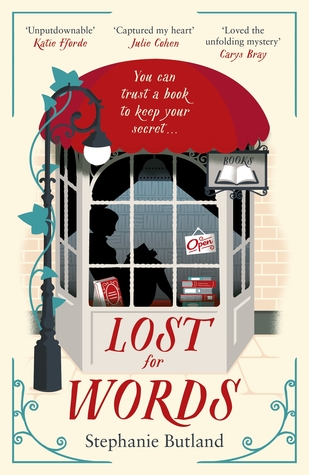
The Lost for Words Bookshop by Stephanie Butland 


Loveday Cardew hasn’t had an easy time of it. When she was only 10 her life fell apart, but 15 years later, she has a job in a bookshop in York, which is ideal for her, because she likes books much more than she likes people. Although Loveday thinks she’s escaped from her past, now it seems like its coming back to haunt her. 

I’ve never read anything by Butland before, but apparently, she’s published several novels already. As a book reviewer, the opportunity to read any book with the word “bookshop” in the title is immediately enticing. The fact that the novel takes place in one of my favorite British cities, York, was also a huge draw for me. Add to this the aspects of a strong female protagonist and a touch of a mystery, and you’ve got me completely sold. I mean, who wouldn’t love a young woman who gets tattoos with the first lines of her most beloved novels (including one of my own all-time favorites, “The English Patient”). 


What I didn’t bargain for with this book was just how humorous this novel would be. Butland draws Loveday with an acerbic wit that is mixed with fierce independence together with a good dollop of self-depreciation, where many of her funnier observances are directed towards the reader, thereby breaking the proverbial “fourth wall.” This works very well because it lightens up some of the heavier aspects of Loveday’s past life. Loveday is also self-aware enough to realize that she doesn’t know everything, and while she’s not ready to work it all out just yet, she knows she’ll have to eventually. It was really a pleasure to watch how Butland developed Loveday, and I feel that this is one of the greatest strengths of this novel. 

The mystery part of this book is also very well devised, and Butland certainly knows how to plant the seeds and not give away too much. In this way, when the mystery is finally solved, it comes with a very satisfactory twist. Mind you, I think some bits of the ending were a bit on the obvious side, with some things a touch too convenient, but I was glad that the last bit of Loveday’s closure wasn’t detailed since that would have been way too much. I always prefer it when some things are left to my imagination at the end of a novel. I should also mention that I was a touch disappointed that Butland didn’t give us more of a feel for the city of York, because I love it so much. However, that might have distracted from the plot and the characters, so I can forgive her for that. 

None of these niggles were any major drawbacks in this book, but there was one thing that kept me from giving this novel a full five stars. That was the inclusion of some poetry. To explain, there’s this love interest for Loveday in this book, named Nathan, and he holds a weekly poetry slam. Despite her initial trepidation, Loveday goes with him, and Butland includes the poem he reads. Later, Loveday reads one of her own poems. No problem there, right? Well, yes there was. To begin with, I wasn’t really impressed with the poems. I found them to be lacking in imagery, somewhat too self-apparent and they seemed more like works of prose that had been artistically chopped up than poems. This is, of course, a matter of taste and I’m sure other readers won’t mind them as much, and one might think that poetry isn’t Butland’s forte. This was why I was even more disappointed when Butland included another poem at the end of the novel that was much more to my liking. However, what really bothered me was when Loveday’s poem appeared, it seemed to be in the exact same style as Nathan’s poem. I’m sorry, but no two poets would write so similarly, no matter how much influence one has on the other. That just felt a bit lazy on Butland’s part, I’m afraid – but I’m willing to bet that this won’t bother most readers. So, although in general, I really liked this book, and can recommend it quite warmly, I can’t give it more than four out of five stars. 


St. Martin’s Press will release "The Lost for Words Bookshop" by Stephanie Butland on June 19, 2018. This book is available (for pre-order) from Amazon, Barnes & Noble, Kobo Books, Kobo audiobooks, iTunes (iBook or audiobook), eBooks.comThe Book Depository (free worldwide delivery), new or used from Alibris or Better World Books as well as from an IndieBound store near you. I would like to thank the publishers for sending me an ARC of this novel via NetGalley in exchange for a fair review.
reade more... Résuméabuiyad

Leaping Late in Life

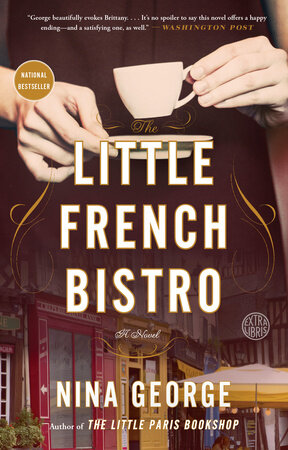
The Little Breton Bistro by Nina George 


When 60-year-old Marianne Messmann is visiting Paris on vacation with her husband, she decides to commit suicide by jumping off the Pont Neuf bridge. Her failed attempt leads her to let her husband go back to Germany on his own and search out the Breton town of Kerdruc. Why Kerdruc? Only because it looked so lovely on a painted tile she found while in the hospital, so why not. What she finds there is far more than she bargained for. 

I truly appreciate a coming-of-age story that involves someone my age, rather than a young person. These types of stories remind us that finding ourselves is not related to age or chronology, and that no matter how old or young we are, there is always something new we can learn about ourselves. This is the biggest reason I wanted to read this book, but also because I found George’s previous novel, The Little Paris Bookshop, to be so charming and fun. That’s was a good enough reason to pick this novel up, if you ask me, but I’m afraid that although I loved the premise, and enjoy George’s writing, I was a touch disappointed with this book, and liked it less than I did her previous novel. 


In a nutshell, I think that George’s mistake here was taking on too many characters this time around. In her previous book the cast was mostly limited to those people on the longboat book shop, with the addition of minor characters they met along the way. Here George seems to include everyone in this town, and since there’s not much traveling involved, wherever Marianne went, there was one of them. In her defense, most small towns often do have all their intrigues bubbling close to the surface of their daily lives, if not on their sleeves in full view, simply because everyone knows everyone else. So, it makes sense that George would allow Marianne to somehow get involved in them all. The problem, however, was that with all these things going on around Marianne, despite her involvement in them, pulled the focus away from her story, which it seems to me should have been front and center. 

While this isn’t a small drawback, I do have to say that overall, this is an extremely pleasant book to read. We grow to love Marianne, get angry with her when she seems to make mistakes and applaud her when she puts herself on the right path. Furthermore, when her husband comes to find her, George cleverly makes us see him, or at least a part of him, in a light that Marianne has denied or at the very least, ignored. Then, when the parts of his personality reappear, which were the very things that kept Marianne away, we realize that everything that made Marianne want to jump off a bridge to a watery death made perfect sense. This is what makes this a life affirming story, and we can admire the type of soul searching required to walk away from a bad situation, particularly at an advanced age like Marianne’s. 

It seems to me that the thing that will make this book a hit (and maybe even as popular as George’s first book), is the softly gentle style that George gives us here, and which has been lovingly translated (again) by Simon Pare. As you read this book, you might see how George likes to caress her readers with her literary style, so that even if some situation or other might feel somewhat harsh, the way it is presented through George’s supple use of words, these harder parts of the story feel almost cushioned. Of course, George’s love for France in general is blatantly obvious in both these books, and George prefers to take us away into parts of the country that are typically very different from the bustling Paris. This will ultimately make you want to pack up your own bags and use these books as your itinerary to discover the nooks and crannies that George seems to adore. Although I didn’t find this a perfect book, and wished it was more focused, I did like it a great deal and it was fun to read. Therefore, I think it deserves a solid three and a half stars out of five, which still means I can recommend it. 


Abacus Press released "The Little Breton Bistro" (also known as "The Little French Bistro") by Nina George in 2017. This book is available from Amazon, Barnes & Noble, Kobo Books, Kobo audio books, eBooks, iTunes (iBook or audiobook), The Book Depository (free worldwide delivery), new or used from Alibris or Better World Books (where your purchase supports world literacy) as well as from an IndieBound store near you.
reade more... Résuméabuiyad

Storms and Longings


Us Against You by Fredrik Backman


Goodreads summarizes Backman’s sequel to his 2017 novel Beartown, saying “After everything that the citizens of Beartown have gone through, they are struck yet another blow when they hear that their beloved local hockey team will soon be disbanded. What makes it worse is the obvious satisfaction that all the former Beartown players, who now play for a rival team in Hed, take in that fact.”

All my readers already know that I am addicted to Fredrik Backman’s novels, and there is good reason for that. However, to prove to them that I don’t automatically adore every word that Backman puts on the page, I’m going to start this review by noting the reasons I almost gave this less than five stars. The biggest reason was foreshadowing. Admittedly, this is a personal pet peeve of mine, which to my chagrin, Backman employed many times throughout this book. I must admit that although it bothered me to begin with, each time he did this, I felt slightly less annoyed. This was probably because he only allowed himself a short sentence of foreshadowing each time.


Another pet peeve of mine is tying up a story too nicely at the end, with the futures of the characters laid out with excruciating detail. While Backman did seem to venture into this forbidden territory of mine, he was able to redeem himself while doing this because he referred to these short foreshadowing bits at the end, which turned this into somewhat of an afterward. So, although we find out things about the futures of several characters beyond the end of the story, it's not like we didn't know about them, and since it was done in a delicately telegraphic way, Backman didn't lay the whole of their lives out for us, but just gave us small tastes. So, despite my initial prejudice against this mechanic, I was surprised to see how much this added to the book instead of detracting from it (which is usually the case).

While the combination of these two pet peeves could normally have made me drop half, if not a whole star off my rating of this book, the way Backman used them so carefully and artfully, made me realize that I can mostly ignore them, and in fact, come to appreciate them in this instance. Furthermore, he had me in tears several times as I got closer to finishing this book – and if I recall correctly, more often than I did with any of his other novels. Backman does this by focusing this novel on base (and sometimes baseless) hatred, and all the nasty things people can do to each other, and then bringing in small acts of kindness that one person shows to someone on the “other side.” I’d say that this is what is almost scary about how talented Backman is, that being how he is able to surprise us and dig deeper into our emotions with each novel.

Remember too, that this is a sequel, and although someone who hasn’t read Beartown might still appreciate this novel as a stand-alone, I would highly recommend they read that one first, since I think they won’t totally “get” everything in this book, if they haven’t read the first one. This is mostly because what was obvious from reading that novel was confirmed with this one. That being, that I am certain that Backman fell in love with his Beartown characters so much that he couldn’t leave them hanging, and had to give us something to help us get closure, which this book does in spades.

I’d also like to mention that this novel felt more poetic than his previous works. This doesn’t mean he uses flowery language, but rather that he gives us many small sub-sections of chapters that are just a few words or a couple of sentences, which we ponder upon as we continue reading. Backman also used another interesting mechanic here that I found interesting, which was how he took a quote from the coming chapter and used it as the title of that chapter. In this way, we can see this quote, and then look forward to where that quote appears and thereby understand its significance. I didn’t notice this at first, but I hope that those of you who decide to read this book based on this review will appreciate my pointing this out for you beforehand.

Of course, all this is just to say that I really loved this book. Again, I’m no fan of hockey, but as a life-long Cubs fan, I can certainly understand the heightened emotions that a lover of one sport or another can have. However, as I noted in my review of Beartown (as well as in my review of Britt-Marie Was Here), the sport itself isn’t what’s important here. Rather it is about all the things that go into what loyalty, love, community, and family mean to us, and how they sometimes blind us into making the types of mistakes that can harm any, or all those things. Backman shines a light on our fragility and makes us realize that sometimes we need to feel pain to discover the humanity we have hidden deep inside. While I want to give this book 4.75 stars out of five (taking off a quarter for the things I noted above), I don’t have a ¾ star, so I’ll round it up to five, and warmly recommend this book!


Atria Books will release "Us Against You" by Fredrik Backman on June 5, 2018. This book is available (pre-order) from Amazon, Barnes & Noble, Kobo eBooks, Kobo audio books, eBooks.com, iTunes (iBook or audiobook), The Book Depository (free worldwide delivery), new or used from Alibris or Better World Books (supporting literacy worldwide) as well as from an IndieBound store near you.
reade more... Résuméabuiyad